





[Home] » [Press Release]
Development of 6G-Oriented Ultra-Wideband Wireless Transmission Testbed in the THz Band and Successful Demonstration of Transmission Under 1,000 km/h High-Mobility Emulation
|
A research group led by Professor Hiroshi Harada and Associate Professor Yusuke Koda at the Graduate School of Informatics, Kyoto University, has developed a 6G-oriented ultra-wideband wireless transmission testbed operating in the terahertz (THz) band around 300 GHz using software-defined radio technology. Under a high-mobility emulation corresponding to speeds of up to 1,000 km/h, the team successfully demonstrated ultra-wideband signal transmission compliant with existing 5G standardized communication specifications, achieving a transmission bandwidth of 7.8 GHz—approximately 20 times wider than the maximum 400 MHz channel bandwidth currently allocated for 5G in Japan—and a data rate of 14.6 Gbit/s. This achievement enables the development and proof-of-concept experiments of communication systems for a wide range of mobility scenarios, from fixed wireless systems to terrestrial mobile communications and non-terrestrial networks. The results are expected to further accelerate research and development of THz-based ultra-high-speed wireless communication systems toward the revolution of 6G.
|
|
1. Background
The fifth-generation mobile communication system (5G) offers key features such as high data rates, large capacity, low latency, and massive connectivity. Today, 5G is expected to evolve further as a critical infrastructure supporting not only individual users but also industrial applications and social systems. Achieving this advancement requires access to broader frequency resources, and the effective utilization of the frequency bands currently allocated for 5G—namely the sub-6 GHz band1 and the millimeter-wave band2 represented by the 28 GHz band—is considered essential. However, as the 5G mobile network continues to expand, concerns have emerged regarding future congestion even in these existing frequency bands, creating a strong need to explore new spectrum resources.
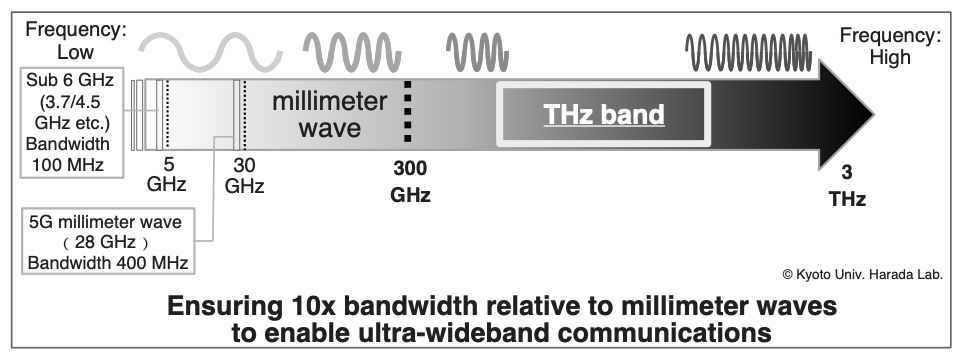
As a promising candidate to address this challenge, terahertz (THz) waves—operating at frequencies approximately ten times higher than those of millimeter waves—have attracted significant attention (Figure 2). The THz band enables the allocation of ultra-wide bandwidths that are tens of times larger than those currently available for 5G, raising expectations for the realization of ultra-high-speed wireless communication technologies, such as wireless transmission of ultra-high-definition video and ultra-high-speed wireless backhaul backbone links.
|
Meanwhile, many of the experimental demonstrations of THz-band communications have been limited to the transmission of modulation waveforms that do not comply with 5G standards. Even in cases where 5G-compliant waveforms were employed, evaluations have been restricted to relatively narrow bandwidths and low data rates that do not exceed the channel bandwidths allocated in existing frequency bands. For sixth-generation mobile communication systems (6G), an important research challenge is to transmit wideband signals on the order of several gigahertz—exceeding the maximum per-channel bandwidth currently used in 5G (400 MHz)—in the THz band while maintaining compliance with 5G standardized transmission schemes, and to clarify the feasibility of reliable communications under diverse environmental conditions. Furthermore, 6G is expected to accelerate the advances of non-terrestrial networks (NTNs), which necessitates support for ultra-high-mobility scenarios with speeds on the order of 1,000 km/h. To meet these requirements, it is necessary to modify various parameters of the orthogonal frequency division multiple access (OFDMA)3 scheme currently employed in 5G so as to ensure stable receiver operation even in THz-band and high-mobility environments. Accordingly, the development of a wireless transmission testbed capable of verifying such configurations has become an urgent task.
2. Research Results
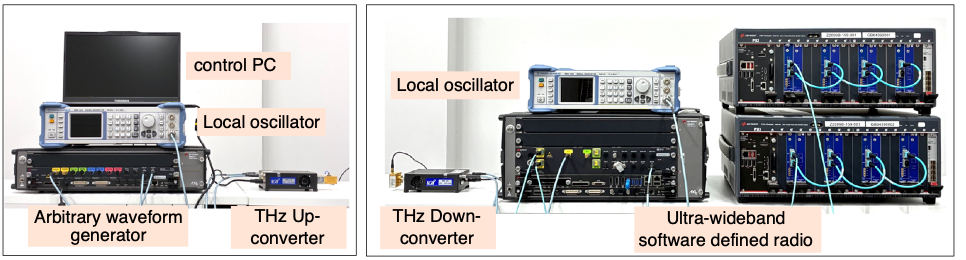
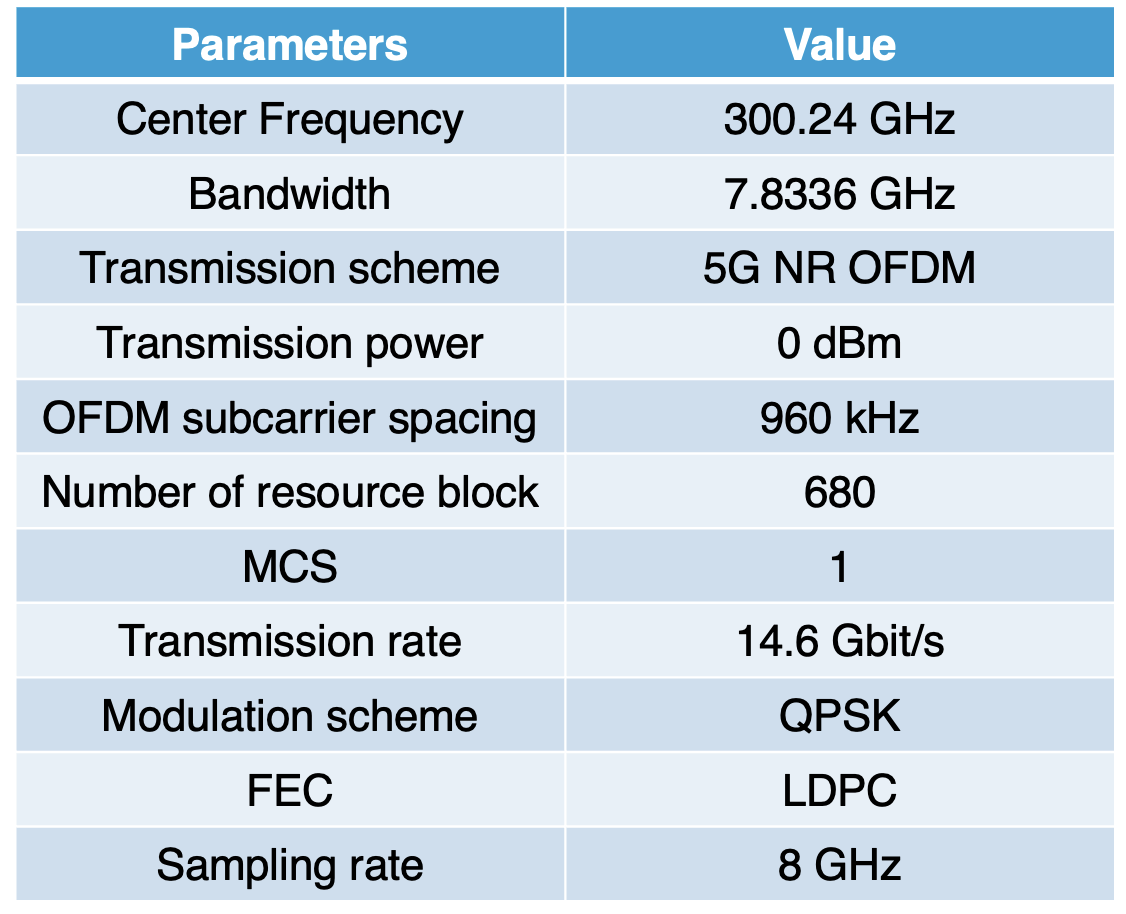
Using software-defined radio technology, we developed a wireless transmission testbed that transmits ultra-wideband signals—approximately 20 times wider than the channel bandwidth currently allocated for 5G in Japan—over the THz band, while conforming to the 5G physical-layer transmission signal formats standardized by 3GPP (3rd Generation Partnership Project). The basic specifications of the developed testbed are summarized in Table 1, and the system configuration of the transmission equipment is shown in Figure 1.
Specifically, the developed transmission testbed has the following features:
- It is capable of transmitting physical-layer signals compliant with the 5G access scheme based on OFDMA in the THz band (300 GHz).
- The subcarrier spacing constituting the OFDMA scheme is increased from the conventional 120 kHz to 960 kHz, while the total transmission bandwidth is expanded to approximately 20 times the current 5G limit of 400 MHz (i.e., 7.8 GHz), enabling data transmission at a rate of 14.6 Gbit/s.
- By adjusting the frequency of the local oscillator in the receiver, the testbed can emulate carrier frequency offset4 in high-mobility scenarios in the THz band (the corresponding mobility is calculated by converting the configured frequency offset into the maximum Doppler frequency that would be generated by mobility)
- A new signal processing scheme has been developed and implemented in the ultra-wideband software-defined radio to automatically estimate and compensate for carrier frequency offset—an issue that becomes critical in high-mobility environments—thereby enabling stable synchronization and reliable reception of transmitted signals.
|
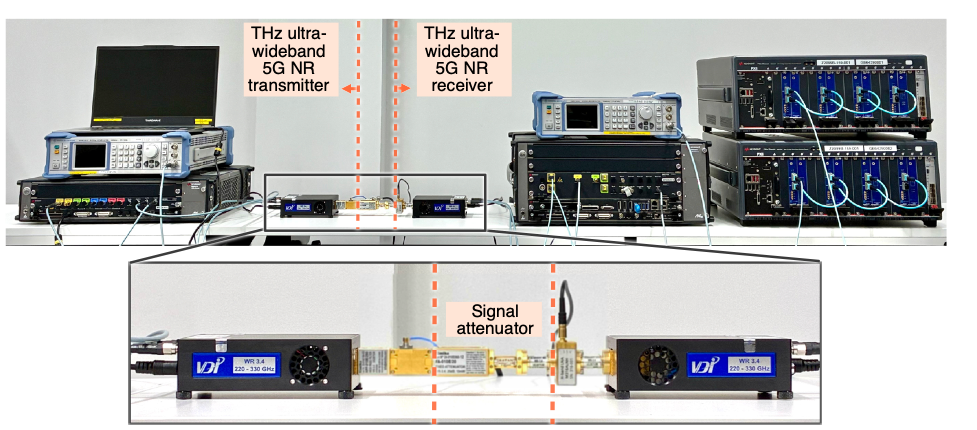
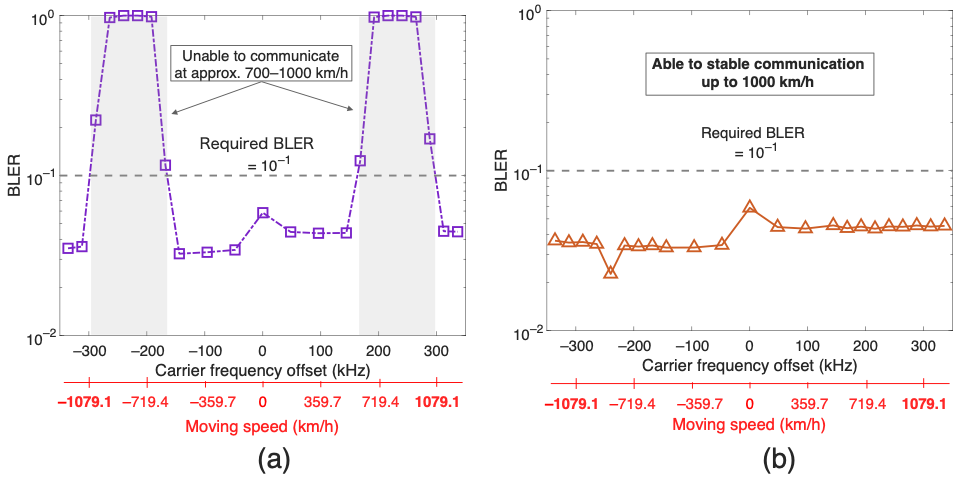
Using the developed testbed, high-mobility emulation corresponding to speeds of up to approximately 1,000 km/h was performed, and transmission performance evaluations were conducted in a laboratory environment (Figure 3). The block error rate (BLER) was measured and evaluated as a key performance metric. In the evaluation, an additive white Gaussian noise (AWGN) channel was emulated by adding noise to the recorded signals using the programing language MATLAB, and the signal-to-noise ratio (SNR) was set to −0.4 dB. When proper synchronization could not be achieved, the corresponding transmission block was treated as an error.
As shown in Figure 4, when the assumed mobility speed was varied up to approximately 1,000 km/h, conventional signal processing methods originally developed for lower-frequency bands failed to achieve the required BLER threshold of 10% in the speed range of approximately 700–1,000 km/h. In contrast, by applying the newly developed signal processing method, the required BLER performance was satisfied across all evaluated mobility conditions. These results indicate that, from the perspective of robustness against carrier frequency offset, stable signal transmission can be achieved even in environments corresponding to mobility speeds of up to 1,000 km/h.
|
|
3. Impact and Future Plans
Verification using the newly developed transmission testbed demonstrated that, when transmitting ultra-wideband 5G signals occupying more than ten times the current 5G channel bandwidth in the THz band, stable signal transmission can be achieved even under a high-mobility emulated environment corresponding to speeds of 1,000 km/h, provided that the receiver is carefully designed to account for carrier frequency offset. This achievement enables the development and proof-of-concept validation of THz-band ultra-high-speed wireless transmission schemes assuming a wide range of mobility scenarios, from fixed wireless systems to terrestrial mobile communications and NTNs. As a result, research and development efforts toward 6G THz wireless communication systems are expected to accelerate further. The research results will be presented at the IEICE Mobile Communication Workshop, scheduled to be held from March 4 to 6, 2026, at Tokyo University of Science.
4. Research projects
A part of this research was conducted as part of contract research projects (JPJ010017C07501 and JPJ012368C0420) sponsored by the National Institute of Information and Communications Technology (NICT).
Terminologies
» 1. sub-6 GHz band:
The frequency band that lies lower than 6 GHz. Generally, in Japan, the sub-6 GHz band is referred to as the band of 3.6–4.1 GHz and 4.5–4.9 GHz, which were additionally allocated for the 5G communication systems.
» 2. Millimeter wave band:
The frequency band ranging from 30 GHz to 300 GHz by definition. Additionally, the 28 GHz band, which is widely allocated for the 5G communication systems, is also referred to as a part of the millimeter wave band.
» 3. OFDMA (Orthogonal Frequency Division Multiple Access)
An extension of orthogonal frequency division multiplexing (OFDM), which transmits data in parallel by dividing it into orthogonal frequency subcarriers. OFDMA allows multiple wireless nodes to simultaneously communicate without mutual interference by assigning different subcarriers to each node. OFDMA was adopted for downlink communication in the fourth-generation mobile communication system, and is now used for both uplink and downlink communication in the 5G.
» 4. Carrier frequency offset
Carrier frequency offset (CFO) refers to the difference between the carrier frequencies used by the transmitter and the receiver in a wireless communication system. It becomes a critical issue particularly in coherent demodulation, where accurate frequency alignment between the transmitter and receiver is required for proper data recovery. Carrier frequency offset arises from mismatches in the accuracies of the local oscillators at the transmitter and receiver, as well as from Doppler effects caused by terminal mobility.
|
Contact Information |